



Play the Demo of Mines
Try the demo here and enjoy a free preview of the game’s adventure and gameplay.
For anyone who has never touched a mines game demo before, this is where the learning curve happens for free. The mechanics of Mines look simple at first glance — click a cell, hope it’s not a bomb. But the relationship between mine count, revealed cells, and multiplier growth has layers that only become clear after playing a few dozen rounds. Demo is the place to build that understanding without paying for it.
Spribe mines demo is available on platforms that carry Spribe titles and offer a demo option. Not every operator enables it. Some require registration first. Others let visitors try the game without creating an account. The availability depends on the platform, not on the game.
What is Mines Demo?
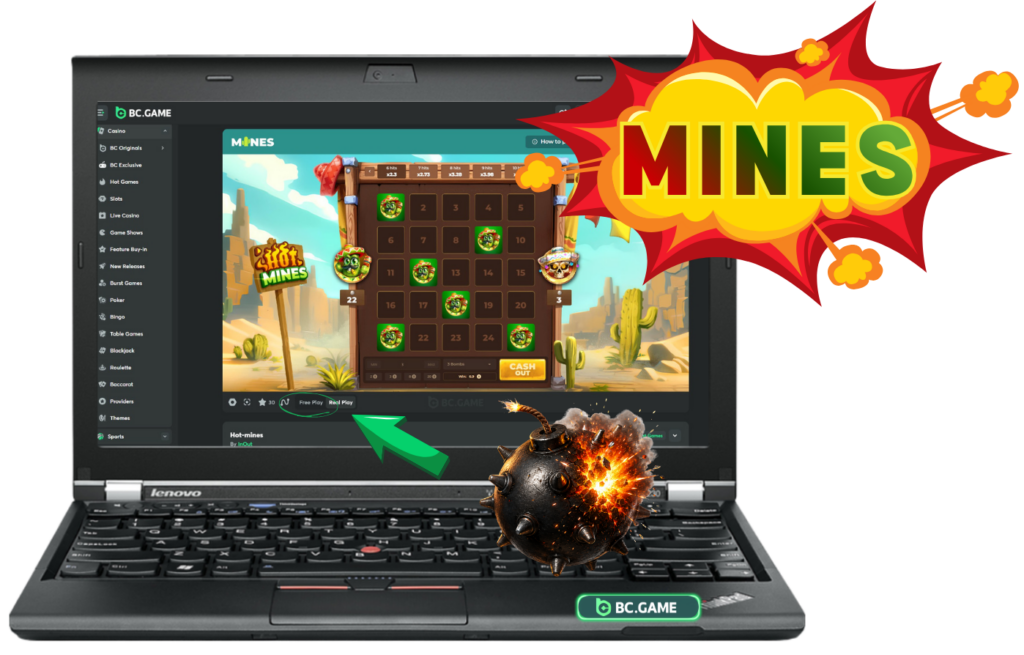
Mines is a grid-based casino game from Spribe, the same studio behind Aviator. The concept borrows from the classic Minesweeper that shipped with older versions of Windows, but rebuilds it as a gambling product with real stakes.
A 5×5 grid. Twenty-five cells. The player picks how many mines to hide — anywhere from 1 to 24. The rest of the cells hold gems. Click a cell. If it reveals a gem, the multiplier updates and the cashout button shows a new, higher amount. If it reveals a mine, the round ends and the bet is gone.
The demo mines game works exactly the same way, except the stakes are virtual. No deposit goes in. No payout comes out. The multiplier math is identical. The grid behaves the same. The provably fair system runs the same algorithm. What’s different is the consequence: a lost round in demo costs nothing, and a won round earns nothing real.
The demo exists for practice. Testing different mine counts. Getting a feel for how the multiplier scales. Building the reflex to cash out at the right moment rather than pushing one click too far. All of this is free in demo mode.
How to Play Mines Demo
The mines demo play experience mirrors real-money play in every functional detail. The controls are the same. The grid is the same. The decisions are the same.
Step-by-Step Guide
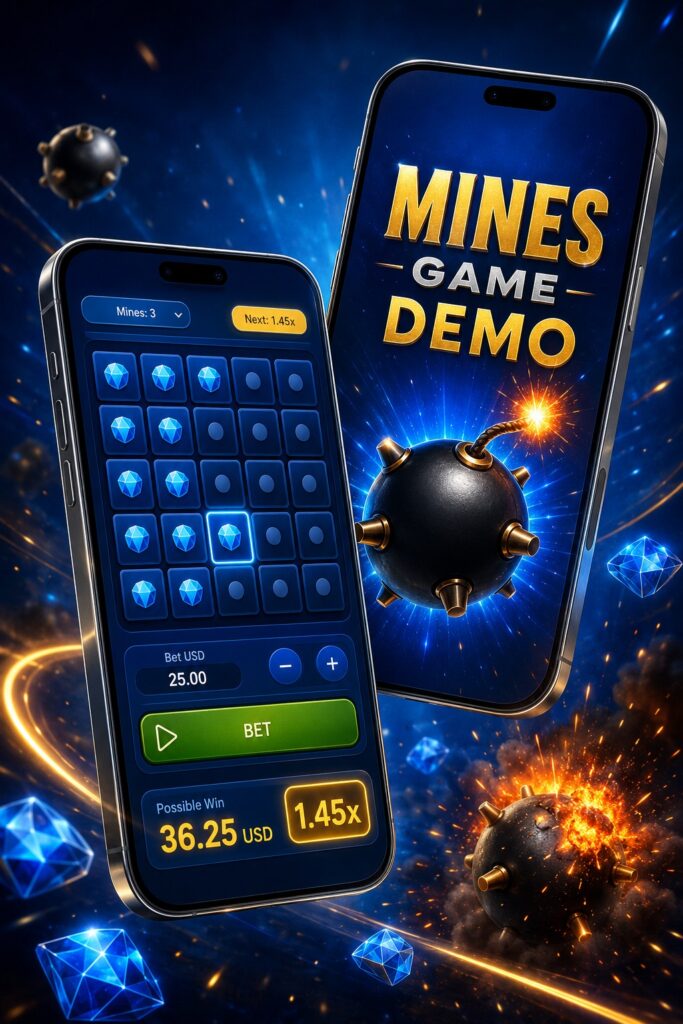
Open a platform that carries Spribe’s Mines and offers demo mode. The game loads in the browser. No download needed.
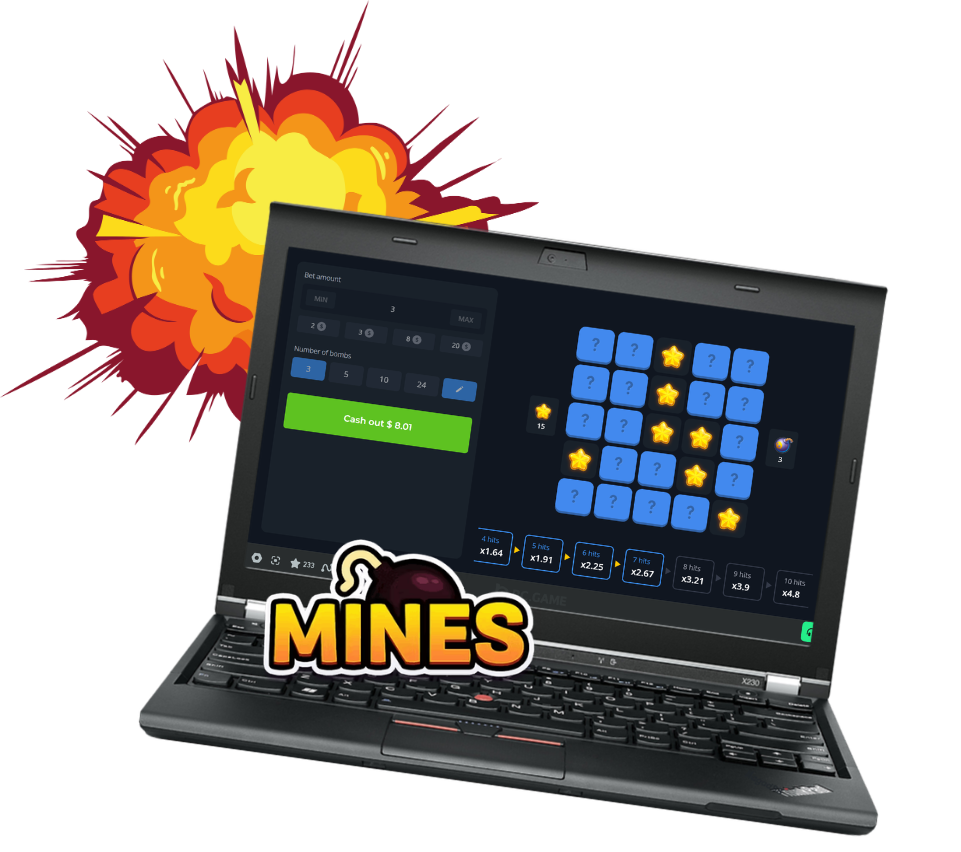
- The control panel shows two main settings. Mine count and bet amount. In demo, the bet uses virtual credits, but the slider works identically to the real-money version. Set the mine count first. One mine means 24 safe cells out of 25. The multiplier per click barely moves. Twenty-four mines means only one safe cell exists on the entire board. Finding it pays a massive multiplier. Missing it — which happens almost every time — ends the round.
- After setting the parameters, the round begins. The grid appears with all 25 cells hidden. Click one. If it’s a gem, the cell opens, the multiplier updates, and the cashout button activates. From this point the player has two options every single time: click another cell or take the current payout.
- Each additional click raises the multiplier. Each additional click also raises the odds of hitting a mine. The tension builds because the math shifts with every revealed cell. Fewer hidden cells remain. The ratio of mines to remaining cells changes. The multiplier reflects that shifting probability.
- Cash out at any point by pressing the cashout button. The virtual credits land on the demo balance. Or keep clicking. If a mine appears, the round ends. The bet amount is deducted from the virtual balance. A new round can start immediately.
Demo Mode Rules
The virtual balance in demo has no monetary value. Credits cannot be withdrawn, converted, or transferred. A demo balance of 50,000 credits means nothing outside the demo screen.
The game mechanics in demo match the real-money version. Same grid. Same mine placement algorithm. Same multiplier calculation. Spribe’s provably fair system generates mine positions before the round starts and allows verification after. Demo rounds are not easier or harder than real rounds. The math doesn’t change based on whether money is involved.
Some platforms offer mines demo play without requiring registration. Others ask for an account but not for a deposit. A few require both registration and a funded balance before unlocking any game, including demo. The access rules belong to the platform, not to Spribe.
Mines Demo Mechanics
The inner logic of the mines game demo follows probability math. Nothing random about the multiplier — it’s a calculated response to the odds of each click being safe.
- A fresh round starts with 25 hidden cells. The player chose a mine count. Say five mines. That leaves 20 gems among 25 cells. The first click has a 20/25 chance of hitting a gem. The multiplier for that first safe reveal is low because the risk is low.
- After one gem is revealed, 24 cells remain hidden. Still five mines among them. But now only 19 gems. The second click has a 19/24 chance. Slightly riskier. The multiplier adjusts upward.
- By the tenth safe click, 15 cells remain hidden with all five mines still in there. The ratio has shifted. Five mines among 15 cells means a 1-in-3 chance of hitting one. The multiplier at this point is noticeably higher than after the first click.
- At twenty safe clicks with five mines, only five cells remain hidden and every single one of them is a mine. The player cannot click again without losing. Cash out here and the payout reflects the cumulative improbability of surviving twenty consecutive clicks with five mines on the board.
- More mines means faster multiplier growth but lower survival odds per click. Fewer mines means slower growth but safer clicks. The player picks where on that spectrum to sit by choosing the mine count before the round starts. Demo is where that choice gets tested without financial consequence.
- The house edge is built into the multiplier calculation. The theoretical payout is slightly less than what pure probability would produce. The difference is the platform’s margin. Spribe publishes the RTP for Mines in their game specifications, and it stays consistent between demo and real-money modes.

Mines Demo vs Real Game
The mechanics overlap. The context around them differs.
| Aspect | Demo Mode | Real-Money Mode |
| Currency | Virtual credits | Real cryptocurrency or fiat |
| Deposit required | No | Yes |
| Winnings | Virtual, cannot be withdrawn | Real, withdrawable after conditions |
| Risk | Zero financial risk | Real financial risk |
| Grid mechanics | Identical to real mode | Same as demo |
| Multiplier math | Same calculation | Same calculation |
| Provably fair | Active | Active |
| Purpose | Learning, testing, practice | Entertainment with financial stakes |
| Emotional weight | Low — nothing real at stake | High — real money on every click |
| Platform rules | Minimal | KYC, wagering, withdrawal limits |
The last two rows matter more than they look. Demo teaches the mechanical side — how multipliers grow, when to cash out, how different mine counts feel. What demo cannot teach is the emotional side. A cell click with $50 behind it feels different from a cell click with fake credits. The stomach tightens. The finger hesitates. Decisions that felt obvious in demo suddenly feel harder when money is real. That gap between demo confidence and real-money pressure is something every player should expect.
Mines Demo Strategies
Demo is a strategy lab. No cost to run experiments. No penalty for bad guesses. The only investment is time.
A strategy in Mines is not a path to guaranteed profit. The house edge exists in every round regardless of approach. What a strategy does is shape the variance — how the wins and losses distribute across a session. Steady small returns versus rare big ones with frequent losses between them. Demo is where a player discovers which shape matches their comfort level.
Low-Risk Demo Strategy
Low mine count. One to three mines on the board. Most cells are safe. The multiplier per click is small. The approach: open many cells per round, accumulate a modest multiplier, cash out before the odds tighten.
In practice this looks like setting two mines, clicking through ten or twelve cells, and cashing out somewhere around 1.5x to 2x. Most rounds survive that far. Some don’t. The balance moves slowly in both directions. Sessions feel calm. No dramatic swings.
The advantage of testing this in demo: running fifty rounds at two mines shows exactly how the balance behaves. How often a round ends early despite good odds. How much the final balance changes after fifty rounds of careful play. The numbers tell the story more clearly than any guide.
Low-risk doesn’t mean no-risk. A two-mine board can still end on the first click. It’s unlikely, but it happens. Demo absorbs those outcomes without financial pain.
High-Risk Demo Strategy
High mine count. Ten mines or more. Every click carries real danger. The multiplier jumps hard after each safe reveal.
The approach: open one or two cells and cash out immediately if they’re safe. The multiplier after a single safe click on a fifteen-mine board is already meaningful. Surviving two clicks gives a strong return. Pushing for three starts to feel like luck more than strategy.
High-risk sessions in demo look choppy. Many rounds end on the first or second click. Lost bets pile up. Then one or two rounds survive long enough to produce multipliers that cover the previous losses and then some. The overall balance might end up near where it started, but the journey there was a rollercoaster.
Testing this in demo reveals something important: high-risk play requires a bankroll large enough to absorb the frequent losses between hits. If the demo balance runs out before a big win lands, the strategy doesn’t work at that bet size. Scaling the bet down or choosing fewer mines becomes the adjustment. Demo is where that adjustment happens without costing money.
At the extreme end — twenty-four mines — the game becomes a single-click lottery. One safe cell on the entire board. Find it and the payout is massive. Miss it (which happens 24 times out of 25) and the bet is gone. Demo shows what fifty rounds of that looks like. Most players find it less exciting than it sounds after watching the balance drain round after round.
Advantages of Mines Demo
The benefits cluster around three themes.
- Learning without cost. The mines game demo teaches grid mechanics, multiplier behaviour, and cashout timing without charging for the lesson. A player who spends an hour in demo understands the game better than someone who reads ten articles about it. Direct experience beats description.
- Strategy testing at zero risk. Different mine counts produce different session profiles. Demo lets a player run multiple experiments back to back. Fifty rounds at three mines. Fifty at ten. Fifty at twenty. The virtual balance tracks the results. No money lost in the process.
- Spribe mines demo is available on casino platforms that carry Spribe’s game catalogue and choose to offer demo access. Not every platform does. Some enable demo for all games. Others restrict it to registered users. A few keep demo behind a deposit requirement, which defeats much of the purpose.
- Emotional calibration. Demo won’t replicate the full pressure of real-money play, but it does build familiarity with the decision points. How it feels when the multiplier sits at 4x and one more click could double it or end everything. That moment is the game. Practising it in demo means it’s not entirely new when real money is on the line.
- Accessibility. Mines demo play runs in a browser. No download. No app. No payment method needed. Open the page, pick a mine count, start clicking. The barrier to entry is essentially zero.
Where to Play Mines Demo
The demo runs inside the platform’s website, not on a separate Spribe portal. There is no standalone Mines app from Spribe with a built-in demo mode. The game loads through the operator’s integration. The operator decides whether demo is available, not Spribe.
When looking for a platform that offers mines demo game access, a few things worth checking. The platform should carry Spribe’s version specifically — other providers have their own Mines variants with different mechanics and different RTP. The demo should use virtual credits, not require a deposit. The platform should be licensed and use HTTPS. If responsible gambling tools are visible in the settings, that’s another good sign.
Demo on one platform may look slightly different from demo on another. Interface skins vary. Button placement might shift. The underlying game — grid size, multiplier math, provably fair system — stays the same because it’s Spribe’s code running underneath.